Reinforcement Learning for Robot Manipulation With Isaac Lab
GPU simulation speeds up robot learning from days to hours.
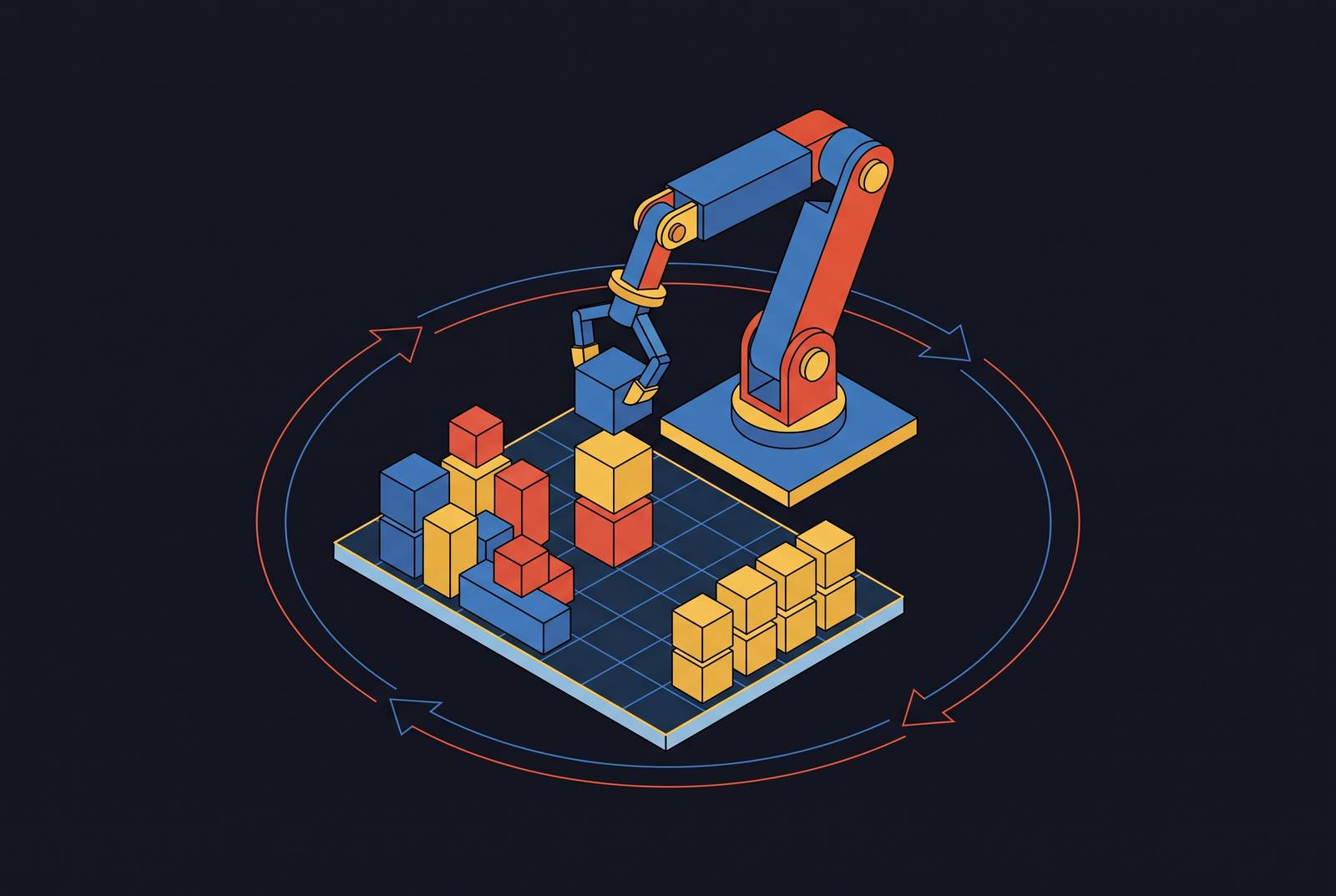
A physical robot arm can run only a limited number of grasp attempts in a full shift, once you count resets, object swaps, and the occasional jam. Reinforcement learning algorithms often need millions of trials to land on a good policy. That math doesn't work on hardware alone, and the gap gets worse as the task gets more precise.
Data collected this way skews toward whatever the lab happened to set up that day, too. A part that slips at a strange angle, a sensor that reads garbage for one frame, a hand reaching into the workspace unannounced: none of that appears often enough in a few hundred daily trials to teach a policy anything useful. Yet these are exactly the situations a deployed robot has to handle without hurting anyone.
Then there's the physical risk, plain and unavoidable. Every real trial risks a bent finger, a stripped gear, a dropped part on someone's foot. Contact-rich tasks, grasping, insertion, assembly, the bread and butter of manufacturing and warehouse work, are the worst offenders here. A small position error at the wrong instant turns a peg into a jam or a gripper into scrap metal, and each failure costs real money and real downtime to fix. Most labs and factories can't afford to run enough hardware trials to train a policy from scratch, and pretending otherwise has held the field back longer than it should have.
Isaac Gym and the Establishment of GPU-Native RL as a Viable Paradigm
NVIDIA's earlier framework, Isaac Gym, made the case that this whole problem could be sidestepped in simulation by running the entire training loop on a single GPU. Physics stepped forward using PhysX, and simulation state came out the other end as PyTorch tensors, ready for a policy network without ever touching the CPU. That one design choice cut out the data-transfer bottleneck that had throttled earlier simulators, and it's the reason GPU-native RL became a serious research category instead of a curiosity.
The results backed the claim up. Isaac Gym trained locomotion controllers, whole-body control policies, in-hand manipulation, dexterous grasping, and industrial assembly tasks, often in a fraction of the wall-clock time that same training used to take on CPU clusters.
But Isaac Gym had gaps, and they became obvious once manipulation research got more ambitious. No real multi-modal sensing pipeline, no modular way to build out complex scenes, no support for deformable objects like cloth or cable, no built-in path for combining RL with imitation learning. Isaac Lab, announced alongside Project GR00T in March 2024, closes those gaps. It folds in the Orbit framework, co-developed with ETH Zurich and the University of Toronto, and builds a wider training environment on top of the same GPU-parallel physics core.
The three architectural pillars Isaac Lab adds on top of GPU-parallel physics
Three additions separate Isaac Lab from its predecessor, and each one answers a specific problem manipulation researchers ran into with Isaac Gym.
Physics fidelity aimed at contact comes first, and it's the one that matters most for manipulation specifically. Isaac Lab still runs on PhysX, but it adds filtered contact reporting, mimic joint systems, and support for closed-loop kinematic chains, features that matter once a task involves a gripper closing around an irregular object rather than a foot hitting flat ground. It also adds real support for deformable objects: cloth, soft bodies, deformable linear objects like cable and wire. These aren't represented as a single rigid transform the way a block or a mug would be. Their state is distributed across the object's geometry, so the simulator tracks how the whole surface bends and folds. Partial kinematic control lets a gripper hold specific points on that mesh while the rest of the object keeps deforming under full physics, the same thing that happens when a robot picks up one corner of a cloth or feeds a cable through a channel. Rigid and deformable solvers run coupled together, which is what makes wire routing or cloth folding look physically real instead of approximate.
Scene construction is the second pillar, built through an open scene-description format designed for describing complex 3D scenes and assets. Every object in an Isaac Lab scene, robots, sensors, target objects, curriculum logic, exists as a "prim" on a shared USD stage. Swapping a coffee cup for a wine glass or a fork doesn't mean rewriting the environment; it's an asset swap on a shared graph. RTX-based sensor simulation, cameras, LIDAR, contact sensors, lives in that same scene graph, which keeps sensor-rich scenes manageable instead of bolted on as an afterthought.
The third pillar governs how actuators and sensors get modeled over time. Actuator dynamics are handled within the simulation framework rather than in a separate module, keeping the training loop efficient. Sensors are modeled to operate at their own natural rates, so varied sensing modalities can feed the same policy without forcing them all onto a single shared clock.
The practical impact of massive GPU parallelism for manipulation training
The headline feature is still what Isaac Gym proved out first: everything runs on-GPU, agent and environment both, with none of the CPU-GPU shuttling that slows down on-policy algorithms like the ones that earlier approach depended on. Isaac Lab keeps that property and pushes it further.
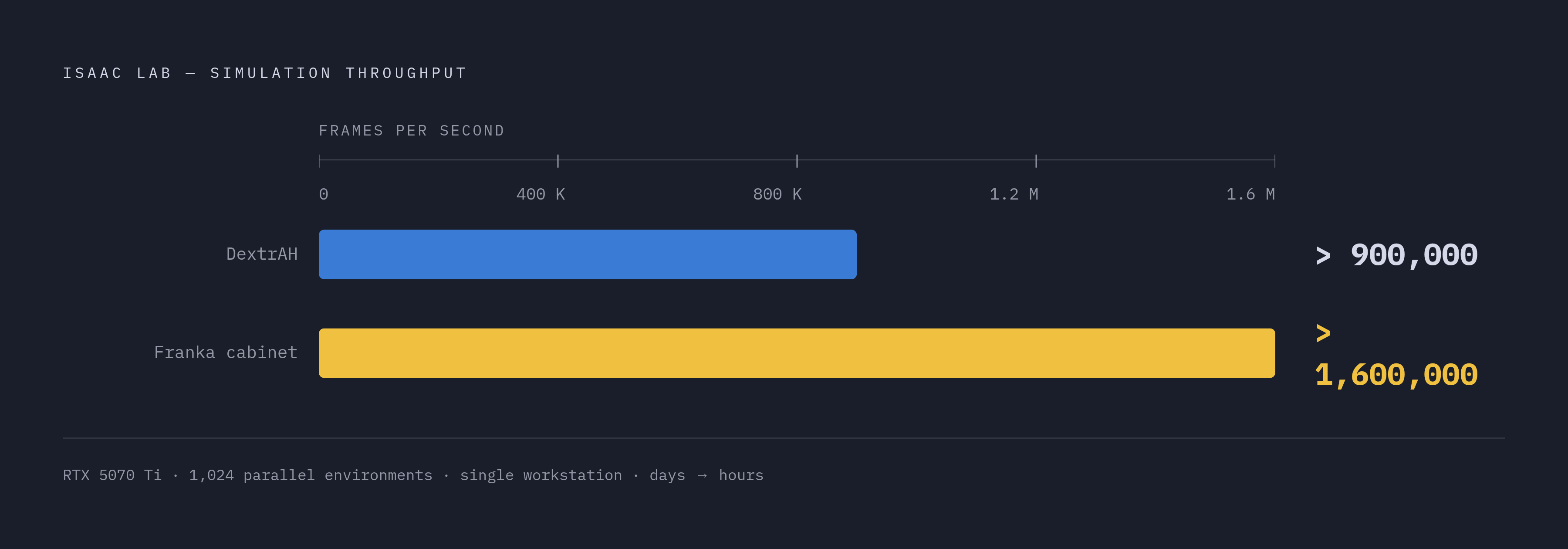
On the low end, a single workstation with an NVIDIA RTX 5070 Ti (16 GB of VRAM) and 64 GB of system RAM can run 1,024 parallel environments at once. That's a machine an individual researcher or a small lab can actually own.
At the high end, published benchmarks describe training runs like the DextrAH teacher task, a grasping-and-lifting problem, racking up over 900,000 frames per second across thousands of parallel environments, and a Franka cabinet-opening task pushing past 1.6 million frames. Distributed setups scale close to linearly as more GPUs get added.
What that means in plain terms: a training run that used to take days on a CPU cluster now finishes in hours on one multi-GPU node. That's not just a speed bump for its own sake, either. It changes how researchers iterate. Reward function design and environment tuning are trial-and-error processes, and when each trial takes hours instead of days, a researcher can work through ten reward-shaping ideas in the time it used to take to test one.
The manipulation task library Isaac Lab ships with and the task families it covers
Isaac Lab ships with over 30 ready-to-train environments, and manipulation sits alongside locomotion and whole-body control as one of the framework's central focuses, not an afterthought bolted on.
The dexterous manipulation suite covers lifting, grasping, and reorienting objects using the KUKA Allegro hand, building on prior research lines like DextrAH and DexPBT. These are high degree-of-freedom control problems where the contact forces involved are small, frequent, and easy to get wrong, exactly the regime where in-hand manipulation research lives.
A separate contact-rich assembly benchmark corresponds to a subset of the NIST Assembly Task Board 1, a standard reference used across robotics research for peg insertion and part-mating tasks. It uses SDF-based contact modeling along with force-aware strategies and optional tactile or force sensing, and prior work has already shown these particular environments transferring successfully from simulation to real hardware.
Then there's WireCraft, a benchmark for industrial deformable linear object manipulation built by the University of Toronto and another research organization (arXiv:2606.18097). It splits into three task families: connector insertion, clip routing, and channel seating, and it supports both articulated and fully deformable cable physics, with trajectories drawn from simulation and from a physical UR5 arm. WireCraft tests reinforcement learning, imitation learning, and vision-language-action policies side by side under shared metrics, and privileged state-based RL clears over 82% success on representative settings within each task family. Connector insertion, the step that demands precise contact-rich alignment, stays the hard part across vision-based RL, imitation learning, and VLA approaches alike, and none of them has solved it yet. The benchmark runs across a UR5 with a Robotiq 2F-85 gripper, a Franka arm, and a Trossen Stationary AI platform in simulation, though real-world validation so far has only happened on the UR5.
Domain randomization in Isaac Lab as a driver of real-world robustness
None of this parallelism matters if a policy trained in simulation falls apart the moment it meets a real robot. The tool Isaac Lab uses to close that gap is domain randomization, widely regarded as a central piece of sim-to-real transfer.
The idea is simple to state, harder to get right in practice: take every physical parameter that's hard to measure precisely or that drifts over time in the real world, friction between an object and a table, an object's exact density, its scale, joint armature, gravity, mass, and randomize it during training instead of pinning it to one value. A policy that only ever sees one friction coefficient learns to exploit that exact number, and that's a trap, not a skill. A policy that sees friction sampled across a wide range learns to handle uncertainty about friction, which is what it'll actually run into outside simulation.
Visual variation handles the same job on the perception side, so a vision-based policy doesn't overfit to one lighting rig in one room. Isaac Lab gives researchers control over when these randomizations fire, so the schedule of variation is a design choice, not an afterthought bolted on at the end.
Sim-to-real transfer results that validate the platform's manipulation training pipeline
Domain randomization is a theory until someone runs it on hardware, and several published results test it directly. Published work has demonstrated door-opening policies for mobile manipulators trained in simulation and transferred to real hardware. Published work has trained pick-and-place skills for humanoid robots across procedural environments generated in Isaac Lab, with scene diversity contributing to stronger generalization.
Earlier sim-to-real work on mobile manipulators demonstrated collision-free movement transferring from GPU-accelerated simulation to physical hardware, with RL-trained models executing comparable movements in both settings. And WireCraft closes the loop most directly: the benchmark supports trajectories from both simulation and a physical UR5, providing a direct path from simulated cable-routing data to a real robot doing the same task.
Combining RL with imitation learning and synthetic data generation inside Isaac Lab
Reinforcement learning isn't the only way to teach a manipulation policy, and Isaac Lab doesn't force a choice between RL and imitation learning. Both live in the same framework. RoboMimic and Isaac Lab Mimic, the latter built on MimicGen, handle the imitation side. A person collects demonstrations directly, and the system uses them to generate far more varied, labeled examples than a human ever recorded by hand.
SkillGen adds another layer. It uses cuRobo, a GPU-accelerated motion planner, to generate hundreds of thousands of collision-aware trajectories with very little latency, which speeds up both pretraining a policy and benchmarking it afterward.
Isaac Lab 2.3 pushed further specifically for dexterous manipulation: a dictionary observation space that lets a policy take in perception data and proprioception data together, and a new evaluation framework called Isaac Lab-Arena, built in close collaboration with Lightwheel on the evaluation and task layers specifically.
Isaac Lab as the training substrate for GR00T and humanoid-scale robot learning
Isaac Lab is the foundational robot learning framework behind NVIDIA's Isaac GR00T platform, the company's push toward general-purpose humanoid robot intelligence.
GR00T N1 is a single model, one set of weights, capable of producing manipulation behavior across single-arm robots, bimanual setups, and full humanoid embodiments. It's been evaluated on standard simulation benchmarks and demonstrated on real GR-1 humanoid robots outside simulation.
The NVIDIA Isaac GR00T Blueprint, built on Omniverse and the Cosmos Transfer world foundation models, generates synthetic manipulation motion data at a scale that's hard to match by hand: synthetic manipulation motion data at a scale that is difficult to match through human demonstration alone. Combining that synthetic data with real demonstration data improved GR00T N1's performance by 40% over training on real data alone. That result says something the field has been slow to accept: synthetic data is an active performance multiplier in its own right. It's an active performance multiplier in its own right, arguably the more important half of the training mix. As of 2026, NVIDIA has released Isaac GR00T N1.7, described as a foundation model for generalist robots.
The Newton physics engine integration for the next generation of manipulation RL
The next architectural shift is already visible on the horizon. Isaac Lab has announced beta availability of Newton, a physics engine that's both fully GPU-accelerated and differentiable, built using NVIDIA Warp.
Differentiability changes what's possible in a fairly deep way. Standard RL learns entirely from reward signals: a policy tries something, gets a scalar number back, and adjusts. A differentiable physics engine lets gradients flow directly through the simulation itself and into the policy, so the learning signal doesn't have to be inferred from reward alone. That has real potential to cut down the enormous sample counts that even GPU-parallel RL still needs today.
For contact-rich manipulation specifically, this matters more than it does for locomotion or navigation. Fine-grained force control, the kind needed for delicate insertion or handling deformable material, is exactly the sort of skill where gradient information through contact events could let a policy learn faster than reward-signal-only RL ever could. Whether that promise holds up at scale is still an open question. Newton is in beta, and the manipulation-specific results aren't in yet. But the direction it points, physics and learning fused at the gradient level rather than connected only through a reward number, is where contact-rich manipulation research is headed next.